Below 80% capacity is our usual line in conversation, but the number alone does not decide a battery replacement. Phones lie politely. A reading of 87% can still shut down at 30% on a cold morning. A reading of 78% can still carry a light day of messages and maps. We look at the health figure, how the phone behaves when it is cold, and whether it dies under load — then we tell you whether keeping the cell is sensible.
This article is the long version of that counter talk: what the percentage means, which symptoms matter more than the score, how we test, what you see before the new pack goes in, and what warranty on a battery actually covers.
What “battery health” is trying to say
Capacity percentage is an estimate of how much charge the cell can hold compared with when it was new. It is useful for spotting age. It is not a full medical chart. Calibration drift, recent fast-charge heat, and software reporting differences between brands all nudge the number. Treat it as one input beside real-world behaviour.
Cycle count, where the phone exposes it, helps too. A high cycle count with mild symptoms can still be fine for light users. A modest cycle count with sudden shutdowns deserves a closer look — cells can fail unevenly, and swelling does not always wait for a low percentage.
Symptoms that usually mean “replace”
Unexpected shutdowns with charge still showing on the bar. Reboots when you open the camera, start navigation, or take a call on mobile data. A phone that only survives the morning even after a full overnight charge. Heat during light use with the bar dropping in chunks. A back glass or screen that is starting to lift because the pouch is swelling.
Swelling is not a wait-and-see item. Stop trapping the phone under books or in a tight wallet. Do not puncture the pouch. Bring it in. We will treat it as a safety job first and a capacity conversation second.

Symptoms that often mean “keep it for now”
A battery that still holds a full light day of chat, email, and a bit of browsing, even if the percentage sits in the low eighties. Slightly faster drain after a big system update that settles over a few charge cycles. Cold-weather sag that recovers indoors without shutdowns. Those phones can wait if you are not ready to spend — we will say so honestly.
We would rather keep a healthy-enough cell in than sell a replacement you do not need. The workshop stays busy with jobs that actually restore a day of use.
How we test at the counter
We read the reported health where the OS allows it. We ask how you use the phone: heavy camera and maps, or mostly messaging. We charge with a cable we trust and watch whether the phone negotiates charge cleanly. If shutdowns are the complaint, we try to reproduce load — screen bright, radios on — rather than guessing from the waiting-room chair.
When the back must come off for another job, we look at the pouch for puffing and at the adhesive for signs of prior heat damage. A battery that looks flat and tests steady can stay. One that is soft, rounded, or pushing the display gets quoted for replacement even if the percentage still looks “acceptable” on paper.
What the replacement involves
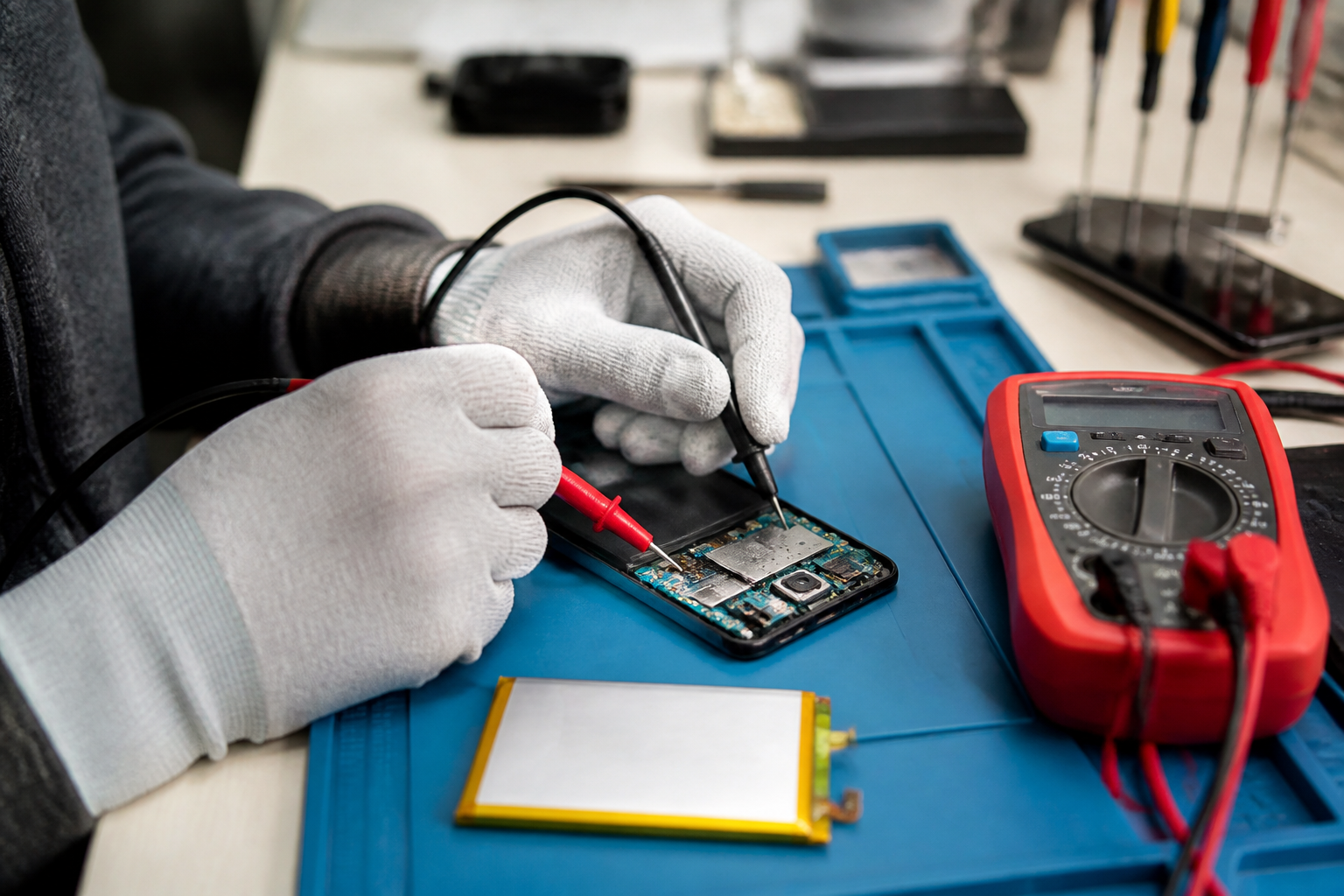
The work is done at the counter or bench with the same care as a screen job. We disconnect power first whenever the design allows it. We show you the part and its box or sealed service pack before it goes in. The invoice names that pack. Old adhesive is cleaned; new adhesive holds the cell so it does not rattle or lift flex cables.
After install we boot, confirm charge both directions where relevant, and watch temperature under a short load. Biometrics, cameras, and buttons get a quick pass so a disturbed flex is caught before pickup. Your data stays put. Back up anyway. Bring your unlock method so we can finish testing.
Charging habits that help the next battery last
Heat is the enemy more than the last 10% of the bar. Avoid soft cases that trap heat during wireless charging under a pillow. Use a cable and brick that are in good shape. Occasional full cycles are fine; obsessive 0–100 rituals help less than keeping the phone out of a hot car.
If your day needs all-day camera and hotspot, no battery chemistry will love that forever. We can still fit a fresh pack when the old one falls over — just know heavy use ages cells faster, genuine or not.
Warranty and “it still drains fast”
A battery warranty covers the part we fitted failing early in a normal way — not a new crack, liquid, or a software bug after an OS update. Keep the invoice. If shutdowns return inside the window with the new pack, that paper is what we open first.
If drain is high but health is fine, we look at rogue apps, always-on radios, and swollen cells that were not the original complaint. Sometimes the battery was never the villain. The long check exists so we do not swap parts blind.
When you are unsure, bring the phone in. We will read the health, watch the behaviour, and tell you whether replacement will actually buy you a longer day — or whether keeping the cell is the smarter call this month.